 Free Shipping for all orders
 Secure payment
 Free Signature Gift Box
 Shop with confidence: encrypted shopping by Shopify

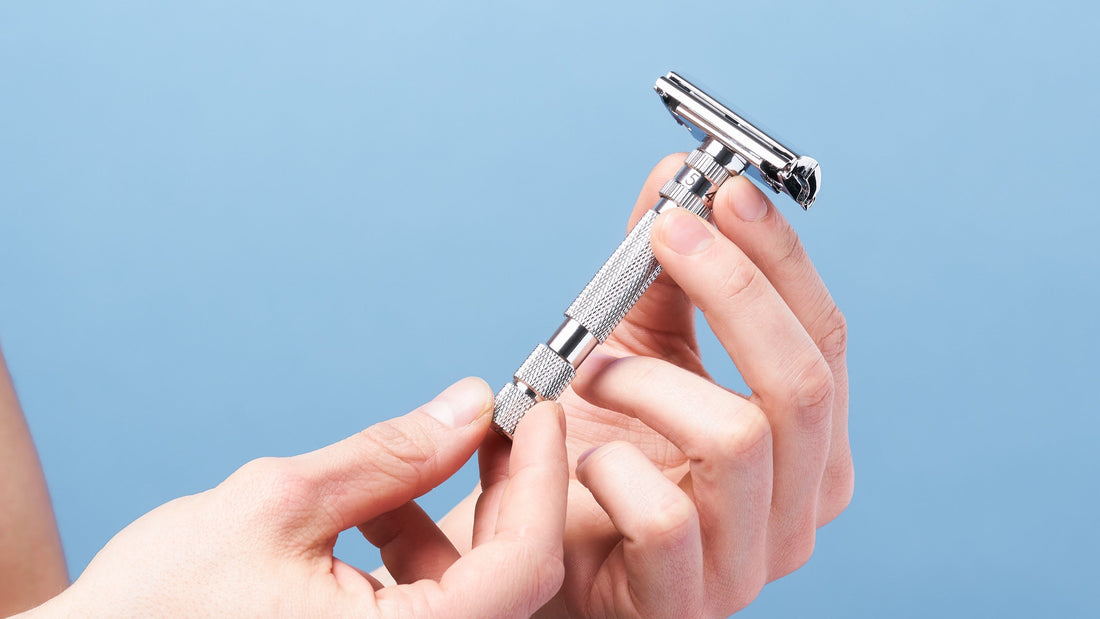
Why trust us: Rockwell's founders designed the 6S and launched it on Kickstarter in 2014, and we've made adjustable safety razors ever since.
Quick answer: The best razor for sensitive skin uses a single blade and is adjustable. Adjustable means you can change the blade gap: the space between the blade and the safety bar, which sets how much hair enters the cutting chamber and is cut in each stroke. Research on shaving irritation points to two causes: pressing too hard and shaving over the same area again (Maurer et al., 2016). Both happen when your razor isn't matched to your hair length. With an adjustable razor, you can dial the gap down for your neck and other sensitive areas and dial it up for a week of growth, so the blade cuts the hair cleanly with less pressure and fewer passes. The Rockwell Razors SETPOINT™ adjustable safety razor does this with a single twisting dial.
The best razors for sensitive skin at a glance
We make razors, so we're not neutral. Here's how the sensitive skin razors we'd actually recommend compare, including two that aren't ours.
|
Razor |
Best for |
Blades per stroke |
Adjustable |
Price (USD) |
|---|---|---|---|---|
|
Sensitive skin overall; different settings for neck and cheeks |
1 |
Yes, stepless dial (0.30–1.10 mm), changes mid-shave |
$149 aluminum, $199 stainless |
|
|
Sensitive skin on a budget |
1 |
Yes, 6 settings via base plates (0.20–0.79 mm) |
$60 |
|
|
Stainless steel with fixed, repeatable settings |
1 |
Yes, 6 settings via base plates (0.20–0.79 mm) |
$120 |
|
|
Fine-tuning with a dial and butterfly loading |
1 |
Yes, dial, settings 1–6 |
$150 chrome, $249 stainless |
|
|
First safety razor |
1 |
Two settings (1 and 3) |
$40 |
|
|
Henson AL13 |
A fixed, mild razor if you never want to adjust |
1 |
No |
$89 |
|
Foil electric shaver |
Daily shavers who don't want a blade on skin at all |
0 (foil) |
Some models |
Varies |
Prices are Rockwell's listed US prices at publication. Every Rockwell comes with 100-day returns, no questions asked. See all Rockwell razors.
Why shaving irritates sensitive skin
Razor burn is your skin reacting to mechanical stress from the blade. Research on shaving points to two causes, and they're linked (Maurer et al., 2016):
-
Pressing too hard. Beard hair is tough to cut. When the razor doesn't cut it cleanly, you press harder and the blade drags across your skin.
-
Shaving over the same area again. When the razor misses some hair the first time around, you tend to shave over the same spot again, and every extra pass adds to the irritation.
Both come from the same problem: a razor that isn't matched to your hair length. Your face isn't one surface. Neck hair often grows in several directions and lies flatter, and stubble length changes from day to day, so one fixed setting can't suit every area. The full research summary is on our razor burn science page, and our guide on how to get rid of razor burn covers the causes and fixes.
What to look for in a razor for sensitive skin
1. One blade
Cartridges put 3 to 5 blades on your skin per stroke. A safety razor puts one. Fewer edges per stroke means less of the skin's surface is scraped on each pass. In a split-face study of 59 men, 40.3% had redness on the side shaved with a single-blade safety razor, against 57.6% on the side shaved with a 3-blade cartridge (Boodoo et al., 2024). A safety-razor maker funded the study. More on this in the truth about multi-blade razors and skin irritation.
2. An adjustable blade gap
The blade gap is the space between the blade edge and the safety bar. A smaller gap lets less hair into the blade's path and shaves milder. A larger gap cuts longer stubble in fewer passes. Sensitive skin needs both: mild where you burn and efficient where your stubble is heavy, so you don't press or re-pass. That's the case for an adjustable razor over a fixed one.
3. Adjustment you can change mid-shave
If your neck needs a lower setting than your cheeks, you want to change it without taking the razor apart. SETPOINT™'s dial turns mid-shave without loosening the head. The 6S and 6C use flip-over base plates, so you choose the setting before you start.
4. A material and weight that suit you
Stainless steel is durable and easy to keep clean. Weight lets the razor do the cutting, so you press less. But heavier isn't automatically milder. In Sharpologist's SETPOINT™ review, the reviewer found the 42 g aluminum version gentler on his neck than the 115 g stainless one, and recommended aluminum.
5. A sharp, fresh blade
A dull blade tugs hair before it cuts it. Change it as soon as the razor starts to pull. Our 100-pack of Rockwell blades keeps a fresh one on hand.
The best razors for sensitive skin, reviewed
Best overall for sensitive skin: Rockwell Razors SETPOINT™ adjustable safety razor
Why it's best overall: it's the only razor here with a continuous adjustment dial you can turn mid-shave, so your neck and cheeks get different settings in the same shave.
Rating: 4.7 out of 5 (70 reviews).
SETPOINT™ is a single-blade safety razor with a continuous dial that sets the blade gap from 0.30 mm (setting 1, mildest) to 1.10 mm (setting 6). You can stop at any point in between, and you can turn the dial mid-shave without loosening the head. One razor can run, setting 1 on your neck and setting 3 on your cheeks in the same shave.
-
Specs: 6061-T6 aluminum (black or silver, 42 g) or 316L stainless steel (115 g); 103.1 mm long; takes any standard safety razor blade.
-
Who it's for: anyone whose neck burns but whose cheeks need a closer shave, and anyone whose stubble length changes day to day.
-
Trade-off: it costs more than the 6C. If your skin is very reactive, start with aluminum and set 1 on the neck.
Best budget razor for sensitive skin: Rockwell 6C
Rating: 4.6 out of 5 (2,560 reviews).
The Rockwell 6C gives you the same six settings as the 6S through three reversible base plates, in chrome-finished alloy, for $60. Start on plate 1. You change settings between shaves rather than mid-shave.
Best stainless steel plate razor: Rockwell 6S
Rating: 4.7 out of 5 (2,427 reviews).
The Rockwell 6S is the 6C's six-plate system in 316L stainless steel, with a lifetime warranty. Plates give you exact, repeatable settings, so once you find the one that works, you get it every time. Sharpologist lists it among its picks for sensitive skin.
Best dial razor with butterfly loading: Rockwell T2
Rating: 4.5 out of 5 (418 reviews).
The Rockwell T2 has a dial with settings 1 to 6 and twist-to-open butterfly doors. It's also on Sharpologist's sensitive-skin list in stainless steel. See which Rockwell is right for you.
Best first safety razor: Rockwell 2C
The Rockwell 2C flips between settings 1 and 3. It's the lowest-cost way to try a single blade if you're coming off cartridges. New to safety razors? Read what to expect from your first shave.
Other razors to consider: Henson AL13 or an electric foil shaver
A fixed, mild razor such as the Henson AL13 suits men who shave daily, never let stubble grow, and want no settings to think about. We compare the two directly in SETPOINT™ vs Henson AL13. A foil electric shaver keeps the blade off your skin entirely. It won't shave as close, but some men with very reactive skin, or curly hair that grows back into the skin, prefer it.
What setting should you use for sensitive skin?
Start low and move up only if the razor stops cutting cleanly. These are SETPOINT™'s starting points from Rockwell's face map.
|
Area |
Start at |
Range |
Move up when |
|---|---|---|---|
|
Neck |
1 |
1–3 |
Stubble is 2+ days long |
|
Upper lip and chin |
2 |
2–5 |
Hair is coarse or longer |
|
Cheeks and jawline |
3 |
3–6 |
You need a second pass to get clean |
Setting numbers don't carry over between Rockwell models, so start low on any of them. The blade gap guide has the numbers for each.
Creators who tested SETPOINT™ found the same pattern. Long Island Shaving got weepers on setting 6 and found setting 3 comfortable. Heiko Shaves had the same experience and finished on 3.
A shaving routine for sensitive skin
-
Soften your hair first with warm water or a warm shower.
-
Never shave dry. Use a shave cream, soap or foam.
-
Set the dial for the area you're shaving.
-
Raise the setting for longer stubble instead of pressing harder.
-
Use light pressure and short strokes.
-
Shave with the grain. For a closer result, re-lather and go across the grain, without stretching the skin.
-
Change the blade as soon as the razor starts to pull.
-
Rinse with cool water and moisturise.
For technique in more detail, see how to shave sensitive skin with a safety razor and our complete guide to using a safety razor. Already switched and still getting irritation? Start with why a safety razor can still give you razor burn.
If you get bumps rather than redness, or the irritation hasn't settled after a week without shaving, see a dermatologist. It may be razor bumps (pseudofolliculitis barbae) or a reaction to a product, not the razor. This article is general information, not medical advice. Our guide to getting rid of razor bumps and razor burn covers what to do next.
Find your setting
Sensitive skin doesn't mean you have to live with razor burn. One blade, the right gap for each part of your face, and less pressure will get you most of the way. Meet SETPOINT™, or compare every Rockwell to find your fit. Rockwell has 10,000+ 5-star reviews and a 100-day, no-questions-asked guarantee.
Frequently asked questions
1. What is the best razor for sensitive skin?
A single-blade safety razor with an adjustable blade gap. It puts one edge on your skin and lets you shave mild where you burn and closer where your stubble is heavy. We recommend the Rockwell Razors SETPOINT™, or the Rockwell 6C on a budget.
2. Is a safety razor better than a cartridge for sensitive skin?
For most men, yes. A cartridge puts 3–5 blades on your skin per stroke; a safety razor puts one. In one split-face study, redness was 40.3% on the safety-razor side and 57.6% on the cartridge side, though a safety-razor maker funded it.
3. What is the best razor for a sensitive neck?
An adjustable razor set low. On SETPOINT™, start the neck at setting 1 and stay within 1–3. Shave with the grain, which on the neck often changes direction. Our guide to razor burn and bumps on the neck shows how to map it.
4. Is an adjustable razor good for beginners with sensitive skin?
Yes. Start every area at a low setting and move up only if the razor stops cutting cleanly. A low setting is more forgiving of angle mistakes. Our guide to using a safety razor walks you through it.
5. Is an electric shaver better than a razor for sensitive skin?
It depends on what irritates you. A foil shaver keeps the blade off your skin, but it shaves less close and many men need several passes. If you want a close shave, a single blade at a low setting is the better choice.
6. Does a heavier razor help sensitive skin?
Weight helps you use less pressure, which matters because pressure drives irritation. But a heavier razor isn't automatically milder; one reviewer found 42 g aluminum gentler than 115 g stainless on his neck.
7. What are the best blades for sensitive skin?
A sharp, fresh blade matters more than the brand. Try a few, then stick with the one that cuts cleanly without tugging. Change it as soon as it starts to pull; a 100-pack of Rockwell blades makes that easy.
8. How do I stop razor burn?
Soften the hair, never shave dry, use light pressure, shave with the grain and keep passes to a minimum. Setting your razor's gap for each area helps you get a clean shave in fewer passes. See how to get rid of razor bumps and razor burn.
9. What blade gap is best for sensitive skin?
Start at the lowest setting: 0.30 mm on SETPOINT™, or plate 1 (0.20 mm) on a 6S or 6C. Move up only if the razor stops cutting cleanly. Our blade gap guide has the numbers for every setting.
10. What if a Rockwell doesn't suit my skin?
Every Rockwell comes with 100-day returns, no questions asked. Read our 10,000+ 5-star reviews or check our FAQ.